
Left to right: Aris Saxena W’21, Yiwen Li W’21 C’21
The rising cost of healthcare combined with the increased demand for services has become a fundamental global dilemma. The lack of both access to services and proper infrastructure in many countries barricades most from achieving positive health outcomes. In these countries, the improper allocation of funds by the public sector creates a systemic problem in which there aren’t enough resources to serve entire populations. Such resources include access to medical professionals, solid road networks, and the availability of crucial medicines. People living in rural areas are primarily left to deal with these issues, often feeling hopeless and in despair.
South Africa is truly unique in its socio-economic makeup. The scars of apartheid still run deep and impact how money, power, and access to resources are distributed across regions within the country. A 15 minute drive can take you from mansions overlooking the Atlantic Ocean to slums where thousands live without access to running water or even homes. This problem is particularly evident within healthcare. Here, 86% rely on a public health system that is overcrowded and underfunded. The remaining 14% get access to a world-class private system that rivals even the world’s most developed countries and accounts for more than half of South Africa’s healthcare expenditure. The tangible consequence of this inequality is that millions are forced to travel dozens of kilometers on foot to their nearest healthcare provider, leaving behind their families and jobs for days at a time. On top of that, there is no guarantee that the medicine they desperately need is even available. The most disturbing part is that this process must be repeated every single month for those suffering from chronic illnesses.
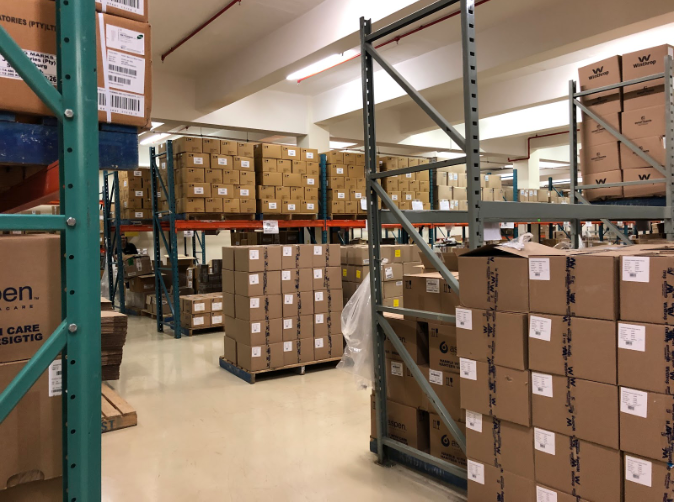
A heavily underfunded and antiquated government wholesale depot used to store medicines before being distributed around the country
Our research project was inspired by one very basic yet complicated question: how can we make it so that patients no longer have to travel far distances for essential medicines? After much deliberation, we believe the answer to this question is Mobility. Mobility is a platform that seeks to mobilize the large population of unemployed youth in South Africa to complete deliveries of chronic medicines from pharmacies to individual households. We seek to do this by facilitating the provision of loans for these individuals from scooter dealerships. However, rather than requiring these youth to repay these loans directly, our platform instead reallocates a proportion of the income they generate from their deliveries to the dealership. The rest is for our drivers to keep. We believe Mobility is the perfect solution to a distribution problem that necessitates thousands of small deliveries to be completed at once. It gives pharmacies a cost-effective way to gain access to a clientele that would otherwise be inaccessible. Additionally, it also aims to drastically increase medical adherence and outcomes by not requiring any additional commitment from the patient outside of picking up their medicines from their doorstep. Essentially, Mobility produces a self-sustaining healthcare supply chain in which patients do not even have to order their medications. The system understands when a new set of medicines is needed.
Furthermore, the beauty of our platform is that we do all of this while empowering South Africa’s future generation. Not only do these previously unemployed youth receive jobs on the spot, but once they have repaid their loans, the scooter is theirs. This means that they are free to take up other jobs, complete their education, or even continue working for us. Rather than tackle South Africa’s medical and employment challenges separately, Mobility connects the two to generate a solution that can be effective in both domains.
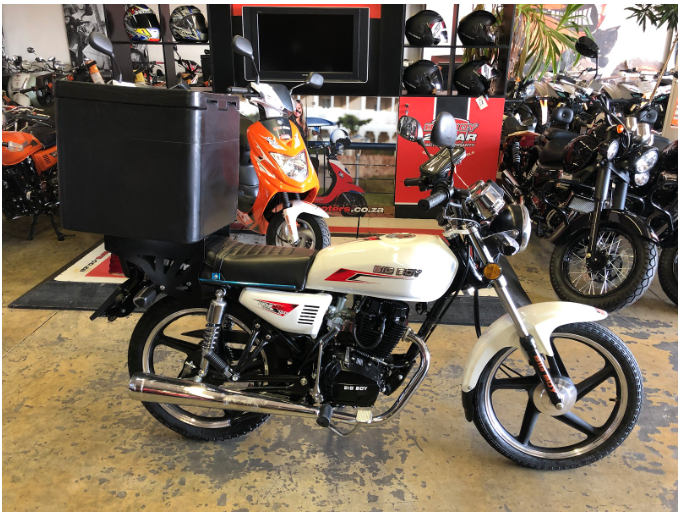
An example of a motorized vehicle to deliver medicine
As we aim to assess the feasibility of our model, we also seek to develop as many connections in the South African healthcare landscape as possible. Our time in South Africa so far has helped to validate our idea, providing supporting evidence both through quantitative data as well as qualitative interviews with stakeholders in the supply chain. We have met with individuals on every level of this complex web of players from pharmaceutical giants such as GSK and Aspen Pharmacare to pharmacies including Medicare Health. Additionally, we have met with players in the public sector from government officials to wholesale depots. However, Mobility’s proof-of-concept is neither conclusive nor significant without proper statistical data outlining the current healthcare landscape. We seek to utilize data from existing companies such as IQVIA, an information company serving the global healthcare industry, to compare Mobility’s model versus the status quo. Extensive research is additionally needed but through this research paper sponsored by the Wharton Social Impact Research Experience, we are excited to conquer these seemingly immutable struggles in global health.
 Mobility: Combating the Global Medicine Shortage By Empowering Youth